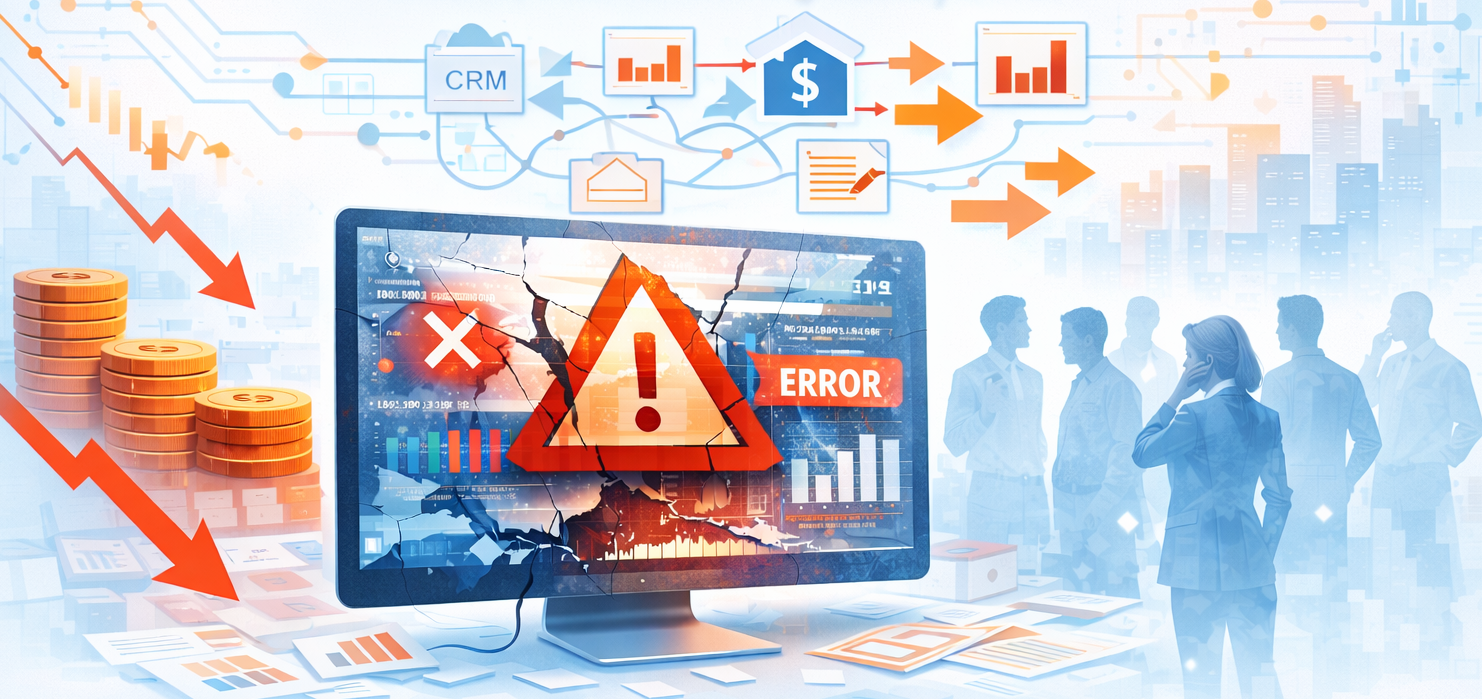
Data quality used to be an analytics problem.
In 2026, it’s a business risk because small errors get amplified fast.
The financial costs are real, too.
That’s the shift a lot of leaders are still catching up to. We’re not just using data to measure the business anymore. We’re using it to run the business. Pricing changes, inventory decisions, customer outreach, compliance reporting, revenue forecasts—those aren’t “dashboard activities.” They’re operational moves. And when the data is wrong, the business moves in the wrong direction with confidence.
The scary part isn’t that errors happen. Errors have always happened.
The scary part is how quickly they spread now.
When data flows through modern stacks—CRM, warehouse, marketing automation, product analytics, finance systems—one bad field can cascade into dozens of reports, automations, and decisions before anyone realizes it. What used to be a cleanup task for an analyst becomes a compounding risk across teams.
And it’s not just internal.
Bad data shows up in customer experiences. It shapes how you segment, how you route leads, how you prioritize accounts, how you forecast demand. It can turn into missed revenue, wasted spend, and compliance exposure—without a dramatic failure that forces attention. It just quietly bleeds performance.
Reliable data changes how an organization behaves
When stakeholders know your data is reliable, decisions happen faster. Teams align more easily. And the organization can pivot with precision rather than hesitation.
This is the part that doesn’t get talked about enough: data quality isn’t only about avoiding errors. It’s about increasing decision velocity.
If you’ve ever sat in a quarterly review where half the time is spent arguing about whose numbers are “right,” you’ve seen the real cost. You can’t run a modern business if every conversation turns into a debate about the scoreboard.
When the data is trusted:
- Finance and Ops stop reconciling reports by hand.
- Marketing and Sales stop fighting over attribution.
- Leadership stops asking for “one more version” of the dashboard.
- Teams move from defending data to acting on it.
That’s leverage. And it’s also why data quality is now a CFO-level issue, not just a data team priority.
Why quality breaks in the first place
Most quality issues aren’t caused by a lack of tools. They’re caused by a lack of standardization and poor collaboration between the teams that produce data and the teams that consume it.
You see it in the usual places:
- Different definitions of the same concept (“active customer,” “qualified lead,” “booked revenue”).
- Multiple systems capturing the same field with different rules.
- Manual data entry “because we’ve always done it that way.”
- No clear owner for a dataset, so quality becomes everyone’s problem and no one’s job.
Without clear data governance policies, technical documentation, and cross-functional accountability, these problems compound over time. The system keeps running, but trust erodes. Then every initiative slows down because nobody wants to build on shaky ground.
So improving data quality requires two things at once: technical controls and organizational alignment. If you only do one, the other will break it.
Five moves that actually reduce data risk
Here’s what works in practice—especially in regulated environments where data problems don’t just cost money, they create exposure.
1) Prevent issues at the point of entry
The cheapest fix is the one you never have to make.
Prevent data issues by automating validation at ingestion, enforcing standardized schemas, and minimizing manual entry across all data sources.
That means:
- Validate required fields and formats before they hit the warehouse.
- Reject or quarantine bad records instead of letting them pollute everything downstream.
- Standardize schemas across systems so you’re not “mapping” forever.
If you’re relying on downstream dashboards to catch upstream problems, you’re already late.
2) Monitor quality in real time, not in quarterly audits
Most organizations discover quality issues when someone important asks a question and the answer feels off.
Monitor data quality in real time and use automated cleansing routines to proactively detect and resolve errors before they impact analytics or downstream systems.
In practice:
- Set thresholds and alerts (null spikes, volume drops, schema drift, duplicates).
- Watch freshness and latency like you’d watch uptime.
- Build a feedback loop so fixes become durable, not one-off patches.
Quality isn’t a project. It’s a control system.
3) Use AI for what it’s good at: pattern detection at scale
Rules-based validation gets you far. It doesn’t get you all the way, especially as datasets become larger and more dynamic.
Leverage AI and machine learning to identify complex anomalies and scale data quality validation on large, dynamic datasets.
The pragmatic use case here isn’t “AI that magically cleans your data.”
It’s AI that flags patterns humans won’t spot:
- subtle shifts in distributions
- inconsistent entity resolution
- relationships that shouldn’t exist (but do)
- anomalies that evade simple thresholds
Think of it as expanding your ability to detect risk, not replacing discipline.
4) Make quality someone’s job, then back them up
This is where most efforts die. Everyone agrees quality matters. Nobody owns it end-to-end.
Foster cross-functional accountability with clear data ownership, targeted training, and shared quality metrics to drive continuous improvement.
That means:
- Define owners for key datasets (not just systems).
- Document definitions where people will actually use them.
- Train the teams creating the data—not just the teams reporting on it.
- Establish shared metrics so producers and consumers feel the impact together.
When the incentives are aligned, quality improves fast. When they aren’t, you’ll be stuck in policing mode forever.
5) Prove ROI like you would for any operational investment
Data quality often gets treated like hygiene work. That’s a mistake. You’ll never keep executive attention that way.
Quantify and communicate the ROI of data quality initiatives to secure ongoing executive support and ensure quality remains a business priority.
A few ways to anchor it:
- Reduced manual reconciliation time (hours → dollars).
- Fewer misrouted leads / wasted campaigns (spend efficiency).
- Faster close cycles because teams trust pipeline data.
- Lower compliance risk through traceability and audit-ready reporting.
Data quality impact is direct: better decisions, higher operational efficiency, and better customer experiences.
The real goal: decision confidence
You don’t invest in data quality because it feels virtuous. You do it because your business is moving too fast to tolerate uncertainty in the numbers.
In most mid-market companies, the stack is already complex. The data is already flowing. The question is whether you’re building on a foundation you can trust—or one that forces everyone to hedge and second-guess.
If you want a simple test, ask this in your next exec review:
Are we debating the decision—or debating the data?
If it’s the second one, you’ve found the bottleneck.